

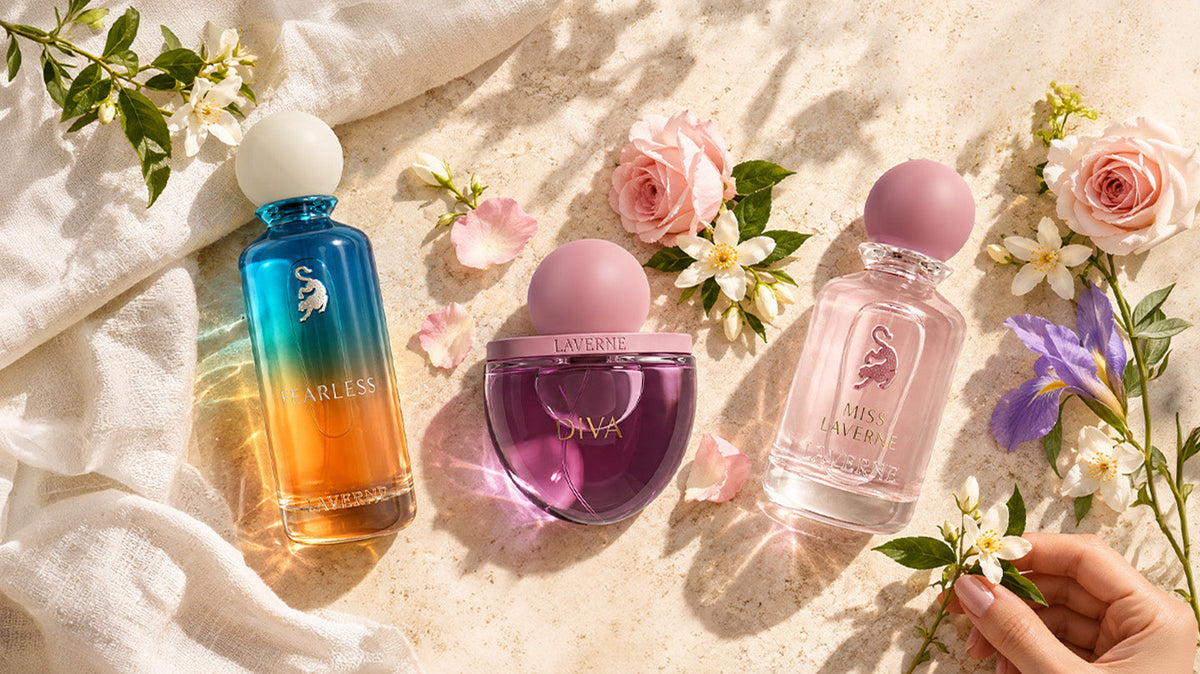
Your fragrance does not remain exactly as it was in the first minute.
It may begin with brightness, settle into a softer floral or aromatic heart, then become woody, musky, warm, or close to the skin.
Understanding perfume notes gives this movement a clearer language. It helps explain how a scent unfolds across a UAE day shaped by warm outdoor air, air-conditioned interiors, work, travel, and evening plans.
The notes pyramid is therefore more than a technical diagram. It is a map of presence: what is noticed first, what becomes familiar, and what is remembered later.

Why do people search for perfume notes?
The question often begins after noticing change.
A perfume felt fresh on a blotter but warmer on skin. A scent that seemed quiet at first developed more character later. A fragrance worn outdoors unfolded differently from the same scent inside.
The search is not only for a definition. It is a way of understanding how a fragrance becomes personal over time.
Notes are an unfolding story
Fragrance descriptions commonly use three layers:
-
Top notes.
-
Heart or middle notes.
-
Base notes.
The layers are not fully separate. The opening becomes quieter as the heart appears, and the heart remains part of the composition while the base settles.
The fragrance does not replace one identity with another. It reveals more of the same structure.
When does understanding notes become useful?
It helps when you are:
-
Discovering a personal scent signature.
-
Choosing a day-to-night fragrance.
-
Shopping for perfume online in the UAE.
-
Comparing two scents in the same family.
-
Looking for a thoughtful fragrance gift.
-
Moving between warm outdoor air and cooled interiors.
-
Trying to understand what will remain after several hours.
How environment changes the scent story
Warm outdoor conditions may make the opening feel more immediate and the transition appear quicker.
Air-conditioned interiors can change how close, soft, or persistent the later stages feel.
Skin chemistry, humidity, fabric, application, and air movement all affect perception. There is no single timeline for every perfume.
A fragrance should therefore be experienced in more than one moment before it becomes a personal signature.
How to read the fragrance pyramid
The pyramid places top notes at the highest point because they appear first.
Heart notes sit in the middle because they form the central character.
Base notes sit below because they support the structure and shape the final trail.
The pyramid explains sequence. It does not give an exact timing promise.
Top notes: how the fragrance enters
Top notes form the first impression.
Depending on the composition, they may include citrus, herbs, light fruit, green facets, or quick spices. They may feel bright, cool, clear, vivid, or lightly textured.
Their role is to introduce the fragrance, not to explain everything that follows.
Is the first impression the whole fragrance?
No.
A fresh opening can settle into warm woods. A light fruit note can lead into florals and musk. Spice may appear briefly before a softer heart develops.
Choosing from the opening alone can result in a scent whose later character feels unfamiliar.
Heart notes: where character settles
The heart becomes clearer as the opening recedes.
Florals, aromatic herbs, fruit, spice, and softer woods may shape this stage. It can feel airy, powdery, green, clean, warm, or calm.
The heart is often where the fragrance begins to feel personal.
Heart notes and scent identity
When searching for a signature, pay close attention to the heart.
It is likely to shape much of the scent experience after the first impact has softened. A heart that feels disconnected from your style may matter more than an opening you enjoyed briefly.
Base notes: the trail that remains
The base becomes more noticeable as the fragrance settles.
It may include woods, musk, amber, vanilla, patchouli, leather, incense-like facets, or other slower-moving materials.
The base still carries parts of the earlier stages. A woody dry-down can retain a floral shadow. Musk can still hold brightness from the opening.
The final trail is not a separate ending. It is the whole story seen more quietly.
Does the opening disappear?
It usually recedes and becomes integrated into the later structure.
You may stop identifying the citrus note separately, but its lightness may remain around the heart and base.
This is why a quieter opening later in the wear should not automatically be understood as poor performance.
How notes connect with fragrance families
Notes describe movement. Families describe the dominant direction.
Floral
A floral fragrance may open with citrus, move through flowers, and settle into musk, woods, or amber.

Woody
A woody scent may begin fresh or spicy before sandalwood, cedar, patchouli, vetiver, or other woods become clearer.

Amber or oriental
An amber scent may open with spice, fruit, or citrus, move through florals or resins, then settle into warmth, vanilla, woods, or musk.
 Citrus or fresh
A fresh fragrance may begin with bergamot, lemon, grapefruit, or green notes before revealing an aromatic heart and a musky or woody base.

Gourmand and leather
A gourmand fragrance may reveal sweetness gradually through vanilla, caramel, coffee, or related notes. A leather fragrance may begin softly or with spice before its drier character appears.
Choosing the scent story for your day
Moving daytime
A clear opening may feel useful, but the heart and base still need to remain comfortable in close indoor spaces.
Day-to-night movement
Look for a fragrance whose opening, heart, and base feel connected. A scent that begins lightly and settles into measured warmth may move more naturally from work into evening.
Settled evening
The base may become more central. Woods, amber, musk, leather, or incense-like facets can create a slower presence when the setting gives them space.
Personal signature
A signature should not be chosen from the fastest part of the scent. The heart and base are more likely to reveal whether you can return to the fragrance repeatedly.
Gifting
Think about what the recipient tends to enjoy after a fragrance settles:
-
A clean musk trail.
-
Soft woods.
-
Warm amber.
-
A floral heart.
-
A fresh opening that remains clear.
A gift feels more personal when it reflects the wearer’s routine and preferred dry-down.
Blotter, skin, and fabric
A blotter shows structure without direct skin interaction.
Skin warmth and chemistry may influence how quickly certain facets emerge and how close the fragrance feels.
Fabric can retain scent differently and may not reveal the same movement.
A calmer testing process is:
-
Use a blotter for the general direction.
-
Select one or two scents for skin.
-
Wait for the heart.
-
Observe the base in a realistic setting.
-
Avoid testing too many perfumes at once.
Common mistakes when reading perfume notes
Treating the opening as the complete scent
Why it happens: The opening is immediately noticeable.
Risk: The later character is overlooked.
Do instead: Wait for the heart to settle.
Looking for every listed note separately
Why it happens: The description presents them as individual words.
Risk: The harmony of the composition is missed.
Do instead: Read each layer as an accord.
Ignoring indoor-outdoor movement
Why it happens: The scent is judged in one environment.
Risk: Its pace may feel different elsewhere.
Do instead: Consider the rhythm of your actual day.
Choosing a signature after one brief test
Why it happens: A final answer feels reassuring.
Risk: The heart or base may not suit repeated wear.
Do instead: Use a discovery format when available.
Treating base notes as a longevity guarantee
Base notes describe the final scent direction. They do not promise a fixed wear time. Formula, skin, weather, and application all matter.
A framework for reading perfume notes
Step 1: Choose the moment
Brief daytime encounter, moving day, transition to evening, or extended evening presence?
Step 2: Define the introduction
Bright, clean, floral, aromatic, soft, or spicy?
Step 3: Define the final trace
Musky, woody, warm, close, dry, or softly sweet?
Step 4: Choose the family
Use the family to narrow the field without treating it as a limit.
Step 5: Read the complete timeline
Top, heart, and base together.
Step 6: Compare calmly
Two or three options within one direction.
Step 7: Test on skin
Especially before choosing a daily signature.
Who is this guide for?
It is useful for anyone:
-
Discovering a personal fragrance identity.
-
Looking for a day-to-night scent.
-
Buying perfume online in the UAE.
-
Trying to understand scent evolution.
-
Selecting a fragrance gift.
-
Choosing a signature that fits several environments.
More care is needed when there is a known sensitivity to fragrance ingredients. Review official information and use specialist guidance where appropriate.
The method also depends on confirmed notes being available in the product description.
Where to begin within LAVERNE
Begin with the trace you want to leave, then return to the opening.
Read the top notes as an introduction, the heart as character, and the base as the quieter memory of the scent.
Understanding perfume notes cannot make every skin experience identical. It can, however, give fragrance discovery a clearer and more personal direction.
Choose by mood, not noise, and discover the fragrance that fits your presence online in the UAE.
FAQ Section
What are perfume notes?
They are layers used to describe fragrance development: top notes introduce the scent, heart notes form its character, and base notes shape the final trail.
How does fragrance change throughout the day?
Faster-moving notes recede, the heart becomes clearer, and the base develops more fully. The pace varies by perfume, skin, and environment.
Does the top note represent the entire perfume?
No. It is the introduction. The heart and base may move in a noticeably different direction.
What is the difference between heart and base notes?
Heart notes form the main character after the opening. Base notes appear later and contribute to the scent that remains.
How do indoor and outdoor environments affect notes?
Warmth and cooling may change how quickly the layers feel noticeable. Skin, humidity, clothing, and application also influence perception.
How do I choose a scent signature from perfume notes?
Focus on the heart and base you can return to regularly, rather than only the opening that attracts you quickly.
Do base notes determine fragrance longevity?
They contribute to the dry-down but do not guarantee a fixed duration. The entire composition and wearing conditions matter.


Leave a comment
This site is protected by hCaptcha and the hCaptcha Privacy Policy and Terms of Service apply.